10 Tips for Buying Cookie Boxes Wholesale
Buying Cookie Boxes wholesale is not simply a price exercise. It is a quality, branding, and logistics decision. A box that looks attractive online may arrive crushed, too shallow, or poorly fitted for iced cookies.
Smithers’ The Future of Global Packaging to 2028 reports continued growth in packaging demand, driven by e-commerce, convenience, and sustainability expectations. Grand View Research also identifies recyclable paperboard and fiber-based formats as important packaging trends. These findings matter for cookie sellers. Wholesale buyers must examine material strength, food-contact suitability, print quality, and shipping performance before placing large orders.
Packaging expert David Luttenberger has described packaging as “a brand’s most tangible touchpoint.” That idea fits Cookie Boxes perfectly. Customers see the box before tasting the product. A clean kraft finish, firm locking tab, and food-safe inner surface can communicate care immediately. Small details matter.
Still, the cheapest carton is rarely the cheapest solution.
This guide presents ten practical tips for comparing suppliers, testing samples, checking dimensions, reviewing minimum order quantities, and calculating delivered costs. It also considers customization, seasonal demand, storage space, and damage rates. Those last factors are easy to overlook. I have seen buyers focus on unit price, then discover that oversized boxes waste tissue paper and increase postage.
Reports provide useful direction, but they cannot replace physical testing. Order samples. Fill them with real cookies. Shake them gently. Inspect the corners afterward. A thoughtful wholesale decision balances appearance, protection, sustainability, and reliable supply.
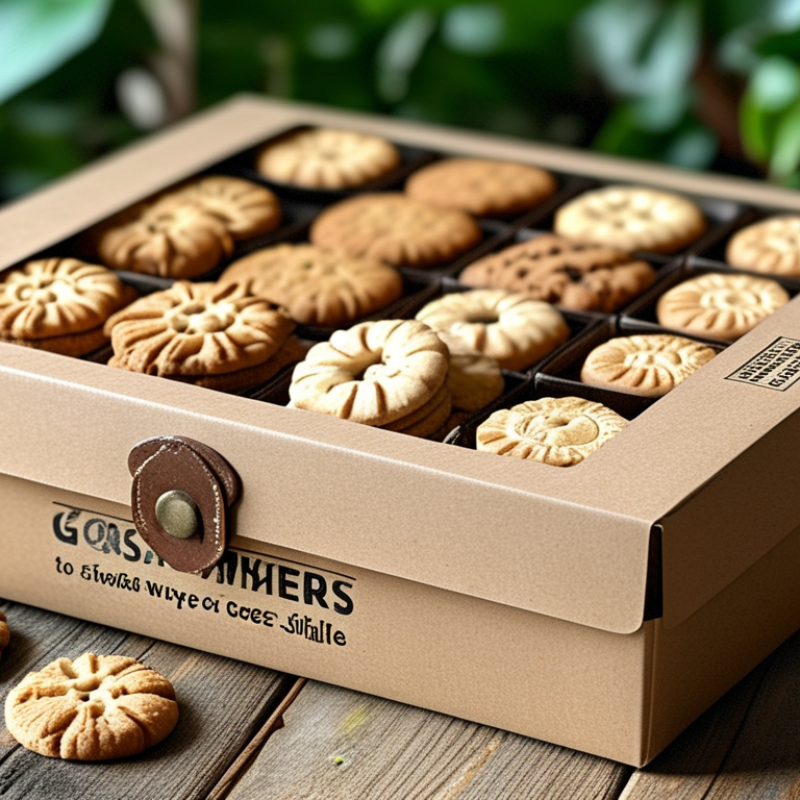
Understanding Your Cookie Box Wholesale Needs
Buying cookie boxes wholesale starts with understanding your products, customers, and packing routine. Measure each cookie’s width, height, and decoration before requesting prices. A soft frosted cookie needs more clearance than a firm biscuit. Otherwise, crushed edges may become an expensive lesson.
Match the box size to the cookie count. Empty space can cause movement during delivery, while tight packaging can damage icing. Test several samples with real cookies before placing a large order. I have found that a small trial often reveals weak corners, loose lids, or difficult assembly.
Check material strength and food-contact suitability. Ask for clear specifications, including thickness, coating, and storage requirements. Your boxes should handle stacking, short-term humidity, and ordinary transport. Think about presentation, too. A clean window, secure closure, and suitable insert can protect cookies while making the package feel intentional.
Calculate your actual wholesale quantity. Estimate weekly sales, seasonal demand, storage space, and likely design changes. Buying too many boxes may lock money into packaging that no longer fits your menu. Buying too few can create rushed reorders and higher shipping costs. I once underestimated holiday demand; the safer estimate was not perfect, but it was closer than relying on optimism.
Supplier communication matters. Confirm production times, sample approval, carton dimensions, and replacement policies in writing. Ask practical questions early. Reliable details prevent avoidable surprises.
Comparing Box Materials, Sizes, and Designs
When buying cookie boxes wholesale, compare materials before chasing the lowest price. A rigid paperboard box feels premium and protects iced cookies well. Corrugated board offers stronger stacking protection during delivery. Kraft paper looks natural, but its surface can absorb oil from chocolate or butter cookies. Add a grease-resistant liner when needed.
The U.S. Environmental Protection Agency reported that containers and packaging represented 28.1% of municipal solid waste generation in its 2018 Facts and Figures report. That figure makes material selection more than a design choice. Ask suppliers about recycled content, coatings, and local recyclability. “Compostable” can sound simple, yet some coatings require industrial composting facilities. I would verify the claim in writing. Assumptions become expensive.
Tip: Test three sizes with real cookies. Leave roughly 6–12 millimeters around each piece, then check movement after closing. Small boxes reduce wasted space, while larger boxes need inserts to prevent sliding.
For six standard cookies, a shallow 8-by-8-inch box may work better than a tall box. Measure your cookies after decoration, not before. Frosting changes everything.
Design also affects labor. Tuck-top boxes assemble quickly, while window boxes improve product visibility but may weaken insulation.
The 2023 Packaging Machinery Manufacturers Institute report identifies sustainability, automation, and right-sized packaging as continuing industry priorities. Compare flat-packed storage, assembly time, print quality, and minimum order quantities. A beautiful box that takes two minutes to assemble may quietly erase its wholesale savings.
Checking Suppliers, Samples, and Product Quality
10 Tips for Buying Cookie Boxes Wholesale
Checking suppliers carefully can prevent expensive packaging problems later. Ask for a current business registration, production address, and clear contact details. Reliable suppliers should explain their materials, printing process, minimum order, and replacement policy. Vague answers deserve caution. Request recent photos of packed orders, but do not treat photos as proof of quality. A short video showing box assembly may reveal weak folds or uneven edges.
Always order physical samples before approving a wholesale quantity. Test several sizes with cookies of different weights and textures. Check whether the lid closes evenly, corners stay firm, and the box resists bending during handling. Measure the inside dimensions yourself. Printed colors may also change between digital previews and finished samples. Ask for a color reference or approved production sample. It matters.
Product quality includes more than appearance. Examine paper thickness, cutting accuracy, glue marks, odor, and surface cleanliness. For boxes touching food, request suitable material specifications and food-contact documentation for your market. Confirm whether coatings affect recycling or storage. I once treated a neat sample as final proof, and that was a mistake; a larger batch showed loose tabs. Repeat checks on pre-production samples. Keep written records of measurements, defects, and agreed tolerances. Suppliers can make honest errors, while buyers can overlook small warning signs when deadlines feel urgent.
10 Tips for Buying Cookie Boxes Wholesale
Suggested 100-point evaluation model for comparing wholesale cookie box suppliers, with emphasis on supplier checks, samples, and product quality.
Use this scorecard to review suppliers consistently: product quality and sample approval should carry the greatest weight, while pricing, minimum order quantity, lead time, packaging protection, and after-sales support should also be verified before placing a wholesale order.
Calculating Prices, Minimum Orders, and Shipping Costs
10 Tips for Buying Cookie Boxes Wholesale
Calculating Prices, Minimum Orders, and Shipping Costs
Wholesale cookie boxes look inexpensive until hidden costs appear. Start by comparing three quantity tiers, not only the lowest quote. Ask whether prices include printing, inserts, setup, and packing. A box quoted at $0.42 may reach $0.68 after these additions. Request a physical sample. Check board thickness, folding accuracy, and grease resistance. These details affect damaged cookies and customer complaints. Confirm the minimum order quantity before approving artwork. A 5,000-unit minimum can create expensive overstock for a small bakery. The U.S. Census Bureau reported $1.1187 trillion in U.S. e-commerce sales during 2023, representing 15.4% of retail sales. Packaging must survive more handling now.
Calculate the landed cost per box. Add the unit price, setup fees divided by quantity, inner packaging, and freight. For example, $0.42 plus $0.08 for an insert and $0.15 for setup equals $0.65 before shipping. A $180 freight bill across 2,000 boxes adds $0.09 each. The practical cost becomes $0.74. Almost right. My first spreadsheet ignored carton dimensions. That mistake underestimated shipping by 18%. Request carton length, width, height, gross weight, and pallet count. Compare actual weight with dimensional weight. Ask for shipping quotes under both scenarios. Include a 5% to 10% budget buffer for fuel surcharges, re-delivery, and damaged cartons. The International Trade Centre’s packaging guidance also stresses moisture protection for paper-based food packaging. Inspect the first delivery before scaling the next order. A cheaper quote is not always cheaper.
Finalizing Customization, Delivery, and Purchase Terms
When buying cookie boxes wholesale, customization should be agreed in writing, not discussed loosely. Start with exact inner dimensions, cookie count, box style, and material thickness. A box that looks elegant may crush during stacking. Request a physical sample for large orders. Check the lid fit, folding points, odor, and grease resistance by placing a cooled cookie inside overnight. Confirm whether paper, ink, and coatings suit direct food contact in your sales market. Ask for a digital proof, then inspect every word, color, logo position, and barcode. Small errors become expensive at scale. Check it twice.
Delivery planning needs more than a promised ship date. Ask when production starts, when goods leave, and how many days transit may take. Separate manufacturing time from transport time. Use a written delivery window with acceptable delays and notice requirements. Confirm carton count, pallet dimensions, protective wrapping, and the inspection process on arrival. Photograph damaged cartons before opening them. It sounds cautious. It saves arguments. Keep a small buffer before seasonal sales; I have seen perfect packaging arrive after the cookies were already sold.
Purchase terms should state unit price, setup charges, sample fees, minimum order quantity, payment stages, taxes, and responsibility for defects. Clarify whether color variation or size tolerance is acceptable. Set a replacement or credit procedure before paying the balance. If artwork changes after approval, record the revised cost and schedule in an email. Do not rely on a friendly promise. Recheck the final invoice against the approved sample. One overlooked line can change the margin. For repeat orders, keep approved specifications and request confirmation before production resumes. Sometimes a simpler box performs better.
| No. | Purchasing Dimension | Practical Data or Standard | Recommended Wholesale Buying Action | Finalization Checklist |
|---|---|---|---|---|
| 1 | Define the Box Size | Measure the cookie diameter, height, quantity per box, and protective space before requesting a quotation. | Prepare a dimensional specification. Allow approximately 3–6 mm of clearance around the product to reduce pressure and movement without creating excessive empty space. | ☐ Internal length, width, and height confirmed ☐ Cookie quantity per box confirmed |
| 2 | Select the Material | Common wholesale options include paperboard, corrugated board, rigid board, and kraft-based packaging. | Match the material to product weight, stacking conditions, moisture exposure, and desired presentation. Use stronger corrugated construction for parcel shipping or heavier assortments. | ☐ Board type specified ☐ Thickness or paper weight specified ☐ Food-contact requirements reviewed |
| 3 | Choose the Box Structure | Popular structures include tuck-end cartons, window boxes, drawer boxes, folding gift boxes, and two-piece rigid boxes. | Choose a tuck-end style for efficient storage and lower costs, a window style for product visibility, or a rigid structure for premium gift presentation. | ☐ Opening method approved ☐ Assembly process tested ☐ Product visibility requirement confirmed |
| 4 | Confirm Custom Printing | Provide artwork in a print-ready format, preferably with vector elements and clearly defined colors. | Ask for a digital proof before production and review text, dimensions, barcodes, nutrition information, color accuracy, and print orientation. | ☐ Artwork proof approved ☐ Text and barcode checked ☐ Color expectations documented |
| 5 | Specify Finishing Options | Common finishes include matte or gloss coating, aqueous coating, lamination, foil accents, embossing, and spot effects. | Use finishing selectively. Matte surfaces can create a soft premium appearance, while gloss or lamination may provide additional resistance to scuffing and handling. | ☐ Finish listed on quotation ☐ Sample reviewed under normal lighting ☐ Food-packaging suitability verified |
| 6 | Set the Minimum Order Quantity | Wholesale minimums vary by box size, printing method, material, and tooling requirements. | Compare the unit price at several quantities, such as 500, 1,000, 2,500, and 5,000 units. Include storage capacity and expected sales volume in the decision. | ☐ Minimum order stated ☐ Tiered pricing requested ☐ Excess inventory risk evaluated |
| 7 | Approve a Pre-Production Sample | A physical sample can reveal fit, color, structural strength, print position, and assembly issues that a digital proof may not show. | Request a sample using the intended material and structure whenever the order is customized or the packaging is being used for the first time. | ☐ Cookie fit tested ☐ Closure and assembly tested ☐ Sample approval recorded in writing |
| 8 | Plan Production and Delivery | A realistic schedule should separate artwork approval, sampling, production, quality inspection, and transportation time. | Request a written timeline with milestone dates. Add contingency time for seasonal demand, port congestion, customs processing, or carrier delays. | ☐ Production lead time confirmed ☐ Shipping method selected ☐ Delivery date and delay process documented |
| 9 | Calculate Landed Cost | Total cost may include packaging, tooling, sampling, freight, insurance, duties, taxes, inspection, and local delivery. | Compare quotations using the complete landed cost rather than the printed box price alone. Confirm whether prices include packing, export documentation, and delivery charges. | ☐ All additional charges listed ☐ Currency and payment terms confirmed ☐ Quote validity period recorded |
| 10 | Finalize Purchase Terms | A purchase order should define specifications, approved artwork, quantity tolerance, inspection standards, payment schedule, and remedies for defects. | Sign off on one complete specification sheet and attach it to the order. Clarify acceptable color variation, quantity variance, replacement policy, and approval responsibilities. | ☐ Final specification attached ☐ Payment milestones agreed ☐ Quality and replacement terms signed |