How to Choose a Lumbar Traction Table?
Choosing a Lumbar Traction Table is not simply a matter of comparing prices or motor strength. The right table should support safe, controlled treatment and fit the clinician’s working environment. It must also suit the patient’s condition, body size, comfort level, and treatment goals. A table that feels impressive in a showroom may become awkward during daily clinical use.
Look closely.
Experienced practitioners usually assess several practical details. These include traction force control, pelvic and chest harness design, table width, height adjustment, noise, and emergency release features. Smooth movement matters when a patient is anxious or has limited mobility. Easy cleaning and durable upholstery also affect long-term reliability. Manufacturer training, warranty coverage, service availability, and documented safety testing deserve equal attention. Marketing claims can sound convincing, but independent clinical judgment remains essential.
There is no perfect model for every practice. A compact table may save space, yet limit positioning options. A powerful motor may offer flexibility, but it can be unnecessary for some patients. Even a well-designed device cannot replace proper assessment and monitoring by a qualified healthcare professional. Before purchasing, compare the table with your actual treatment room, patient population, and maintenance resources. Ask for a demonstration when possible. Test the controls, examine the locking points, and notice how easily a patient can enter and leave. Small details often reveal more than brochures. This guide explains the main selection factors while acknowledging that some decisions require further clinical reflection.
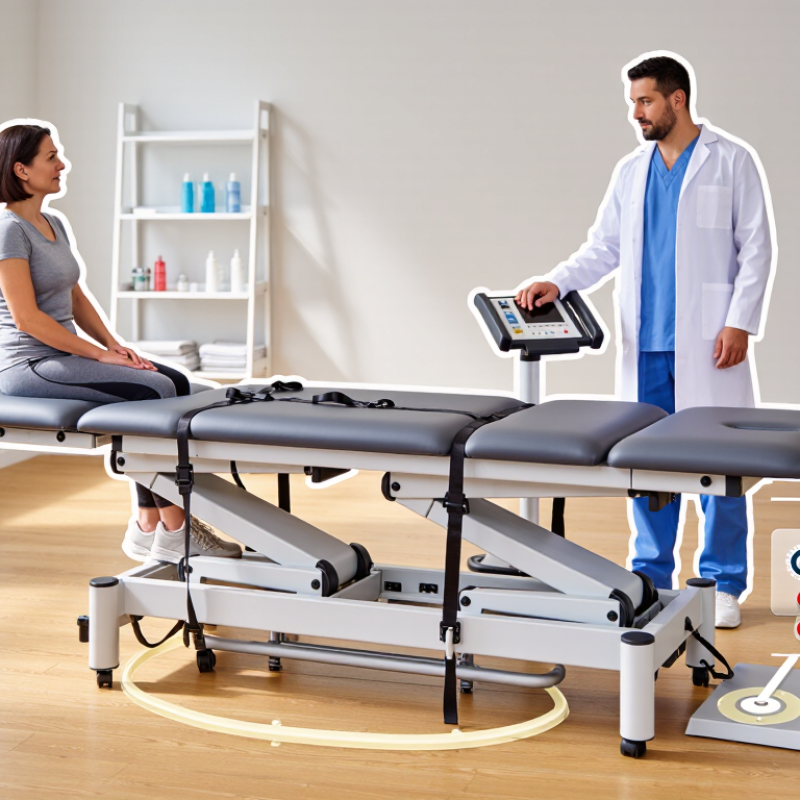
Define the Purpose and Clinical Requirements of the Traction Table
Choosing a Lumbar Traction Table should begin with a clear clinical purpose, not a catalog of features. Define whether the table will support intermittent traction, sustained traction, positional unloading, or flexion-distraction work. Each approach requires different movement control, patient positioning, and clinician access. A patient with radiating leg pain may need a different setup from one with restricted lumbar mobility. The table must serve the assessment.
Review the conditions treated in your clinic and the patients who will use the table. Check weight capacity, height range, pelvic and thoracic restraints, padding, and adjustment speed. A short patient may slide if the pelvic support is poorly shaped. A larger patient may need wider surfaces and stronger locking mechanisms. Electric controls should allow smooth, measured changes, while emergency release must be easy to reach. Ask whether staff can clean every seam thoroughly. Small design details affect daily reliability.
Clinical requirements also include screening, documentation, and staff training. A trained clinician should identify relevant risks and monitor pain, numbness, and dizziness during treatment. The table should help record angle, force, duration, and patient response consistently.
Clear controls reduce guesswork between practitioners. Confirm suitable safety documentation and maintenance procedures for your region. Do not choose maximum force simply because it is available. More is not always better.
I would test the table with a trained colleague before purchase, because brochures cannot show every transfer problem. Reassess the choice after real appointments; the first decision may be imperfect.
Compare Lumbar Traction Methods, Features, and Adjustment Options
How to Choose a Lumbar Traction Table?
Lumbar traction tables differ in method, control, and patient positioning. Motorized traction delivers programmed pulling cycles, while manual traction depends on clinician technique and physical consistency. Static traction holds one force; intermittent traction alternates pulling and releasing. The choice should match the assessment, not a dramatic specification sheet. The World Health Organization reported that approximately 619 million people experienced low back pain in 2020, with cases projected to reach 843 million by 2050. That scale demands careful equipment decisions.
Compare adjustment options closely. Look for adjustable pelvic and thoracic supports, a split-table design, and precise control of force, cycle time, and treatment angle. A wide force range helps clinicians begin gently and progress gradually. An accessible emergency release matters. So does clear weight guidance. Small details count, such as padded harnesses that do not press sharply against the hips. A polished control panel cannot correct poor positioning.
Evidence remains mixed. A Cochrane review of 32 studies found little or no meaningful benefit from traction for many low back pain outcomes, with generally low-quality evidence. Therefore, traction should support a broader clinical plan, not replace examination, movement training, or patient education. I would not select a table by maximum force alone. That is an easy mistake. Record the patient’s response, comfort, symptoms, and recovery after each session. Reassess often. Adjustment is part of the treatment.
How to Choose a Lumbar Traction Table? - Compare Lumbar Traction Methods, Features, and Adjustment Options
| Traction Method | How It Works | Key Adjustment Options | Patient Position | Typical Clinical Use | Main Advantages | Important Limitations |
|---|---|---|---|---|---|---|
| Intermittent Mechanical Traction | A motorized system applies and releases longitudinal pulling force in repeated cycles. | Traction force, hold time, rest time, cycle count, treatment duration, and sometimes ramp speed. | Usually supine; some tables support prone positioning. | Short-term symptom management when a clinician determines that mechanical traction is appropriate. | Repeatable treatment parameters, programmable cycles, and reduced physical effort for the practitioner. | Clinical response varies; it requires correct pelvic and thoracic stabilization and should not be used without screening. |
| Sustained Mechanical Traction | A relatively constant longitudinal force is maintained for a selected period. | Force level, treatment time, patient position, harness placement, and gradual force ramp-up. | Most commonly supine, with the pelvis secured by a pelvic harness. | Cases in which a steady, gentle unloading sensation is preferred by the treating professional. | Simple protocol structure and consistent force delivery during the active phase. | May be uncomfortable for some patients and can aggravate symptoms if force, positioning, or duration is unsuitable. |
| Flexion-Distraction | A practitioner-guided table movement combines lumbar flexion with a controlled distraction or oscillating motion. | Flexion angle, table drop or movement range, pelvic section motion, and manual contact or stabilization. | Usually prone, with the patient supported on a split or movable pelvic section. | Selected lumbar mobility and manual therapy programs where controlled flexion is clinically indicated. | Allows hands-on assessment and segmental movement with highly adjustable table motion. | Requires practitioner training and active control; it is not equivalent to unattended motorized traction. |
| Manual Lumbar Traction | The practitioner applies traction through the patient’s legs, pelvis, or trunk using controlled hand-applied force. | Direction, force, rhythm, contact points, duration, and patient position can be modified immediately. | Supine, side-lying, or other positions depending on the technique and patient tolerance. | Initial assessment, symptom-response testing, or treatment requiring continuous clinician feedback. | Highly responsive to patient feedback and does not require a motorized traction unit. | Force and timing are less standardized and depend substantially on practitioner skill and endurance. |
| Split-Table Traction | The table separates or moves selected sections to create controlled longitudinal movement while the patient is stabilized. | Table separation, movement speed, force, section locking, pelvic fixation, and treatment duration. | Commonly supine; positioning depends on the table design and treatment protocol. | Clinics seeking a dedicated traction platform with repeatable positioning and programmed movement. | Can provide stable support, accurate positioning, and easier transfer between treatment settings. | Higher purchase and maintenance requirements than a standard treatment table; compatibility with patient size must be checked. |
| Inversion-Based Traction | The body is tilted head-down to use body weight and gravity to produce spinal unloading. | Inversion angle, hold time, transition speed, ankle fixation, and return-to-upright control. | Secured in a tilted or inverted position with the feet or ankles fixed. | Limited, carefully screened use where an inversion approach is specifically appropriate. | Uses gravity rather than a powered pulling mechanism and may offer a different unloading sensation. | Not suitable for many patients, including some with cardiovascular, ocular, vestibular, or balance-related concerns. |
Selection should be based on patient screening, clinician training, table weight capacity, pelvic and thoracic stabilization, emergency release access, and the ability to adjust force and positioning gradually.
Evaluate Table Size, Weight Capacity, and Patient Comfort
Choosing a lumbar traction table starts with patient dimensions, not room aesthetics. Measure the table’s usable width and length, then compare them with the patient’s shoulder, hip, and leg span. The CDC’s National Health and Nutrition Examination Survey reports average adult weights of about 200 pounds for men and 171 pounds for women. Those averages hide important variation. A narrow surface may feel restrictive, especially during pelvic strapping or repositioning. Allow several inches of clearance without creating gaps that reduce support.
Weight capacity requires more than matching the patient’s scale reading. Include clothing, braces, bolsters, and the table’s moving sections. A practical purchasing review should examine the working load, not only the static rating. The National Institute for Occupational Safety and Health emphasizes controlling force, awkward posture, and manual-handling exposure in clinical work. Smooth height adjustment and stable locking can reduce unnecessary staff strain. Capacity alone is not enough.
Patient comfort affects cooperation and treatment consistency. Check padding thickness, face-rest pressure, strap placement, and noise during section movement. The World Health Organization estimates that low back pain affected 619 million people in 2020, so clinics may serve patients with very different sensitivities and functional limits. Test the table with a shorter patient, a heavier patient, and someone with limited mobility. That assumption can fail. A soft surface may still create painful pressure points, while excessive cushioning can reduce positioning control. Ask patients where support feels uneven, and record those observations before making a final purchase.
Check Safety Standards, Durability, and Ease of Maintenance
How to Choose a Lumbar Traction Table?
Safety should be checked before comfort or appearance. Look for compliance with IEC 60601-1, which addresses basic safety and essential performance for medical electrical equipment. ISO 14971 is also important because it guides medical-device risk management. Ask for test records, not only a certificate. A table should include controlled force adjustment, emergency release, secure patient straps, and clear load limits. The controls must remain reachable during treatment.
Durability appears in ordinary details. Inspect welds, hinges, cables, padding, and moving rails. Listen for uneven motor noise. A smooth first inspection can still miss hidden wear. WHO reported that low back pain affected about 619 million people in 2020 and may reach 843 million by 2050. That growing clinical demand makes reliable equipment more important. Choose components that can tolerate repeated daily cycles, not occasional demonstration use.
Maintenance should be simple enough for busy staff. Surfaces need to withstand approved disinfectants without cracking or becoming sticky. Check whether belts, cushions, fuses, and cables are replaceable. The FDA’s MAUDE database shows why post-market monitoring matters: device problems are reported after real-world use, not just laboratory testing. Keep service logs, inspection dates, and operator training records. A table that requires specialist service for every small adjustment may become expensive. I would still request a trial period, because specifications rarely reveal cleaning effort, noise, or awkward access.
How to Choose a Lumbar Traction Table?
Check safety standards, durability, and ease of maintenance before making a purchasing decision.
This suggested evaluation model assigns the greatest priority to safety because a traction table supports patients under controlled mechanical loading. Durability reflects frame strength, actuator reliability, and rated patient capacity, while ease of maintenance covers cleaning access, replaceable components, inspection procedures, and service documentation. Always verify applicable medical-device and electrical-safety requirements in your region.
Review Costs, Warranty Coverage, and Supplier Support
How to Choose a Lumbar Traction Table?
A lumbar traction table should be judged by its total ownership cost, not its purchase price. I have found that delivery, installation, staff training, and room preparation can change the budget quickly. Request a written quotation with every charge listed. Ask whether electrical upgrades, calibration, or replacement straps cost extra. A cheaper table may become expensive when service delays interrupt appointments.
Warranty coverage deserves careful reading. Check the warranty period for the frame, motor, controls, upholstery, and accessories. Some suppliers cover parts but exclude labor, shipping, or on-site visits. Ask how claims are submitted and how quickly technicians usually respond. Read every clause. Also confirm whether routine maintenance is required to keep coverage valid. I once underestimated this requirement, and the follow-up costs were higher than expected.
Supplier support often separates a dependable table from a frustrating purchase. Look for clear manuals, remote training, maintenance schedules, and readily available replacement parts. Ask for service response times in writing, not only during a sales call. A reliable supplier should explain limitations honestly and provide references from clinics with similar workloads. Ask difficult questions. Can they support older equipment? What happens during a software or motor failure? If answers remain vague, reconsider the purchase. Personal demonstrations are valuable because noise, movement, and patient comfort are difficult to judge from specifications alone.