How to Choose the Best Wine Filters for Global Buyers
Choosing the best wine filters begins with a clear understanding of the wine, the cellar, and the target market. A filter that protects a delicate white wine may remove desirable texture from a full-bodied red. Global buyers must examine pore size, membrane material, flow capacity, pressure limits, and certification records. They should also ask how the filter performs during real production, not only in laboratory conditions.
Dr. Bruce Zoecklein, a respected wine scientist and author, stated, “Filtration is not a substitute for sanitation.” This principle remains essential. Even the finest wine filters cannot correct dirty tanks, unstable wine, or careless handling. A reliable selection process considers microbial stability, clarity requirements, oxygen exposure, and the bottling environment. For example, a producer exporting sparkling wine may need sterile membrane filtration, while another producer may prefer depth filtration to preserve mouthfeel.
Small details matter.
Buyers should request technical data sheets, batch consistency evidence, and compatibility information. They should compare wetting procedures, cleaning limits, and disposal requirements. Cost alone can mislead. A cheaper filter may clog faster, waste more wine, or create inconsistent results between lots. That said, no universal answer exists. Regional water quality, equipment design, and winemaking style can change the outcome.
Some recommendations will still need revision after trials. That is normal. A practical test with the actual wine remains more trustworthy than a polished sales claim. The strongest purchasing decision balances filtration performance, product integrity, supplier support, and documented quality controls. Wine filters should serve the wine, not dominate it.
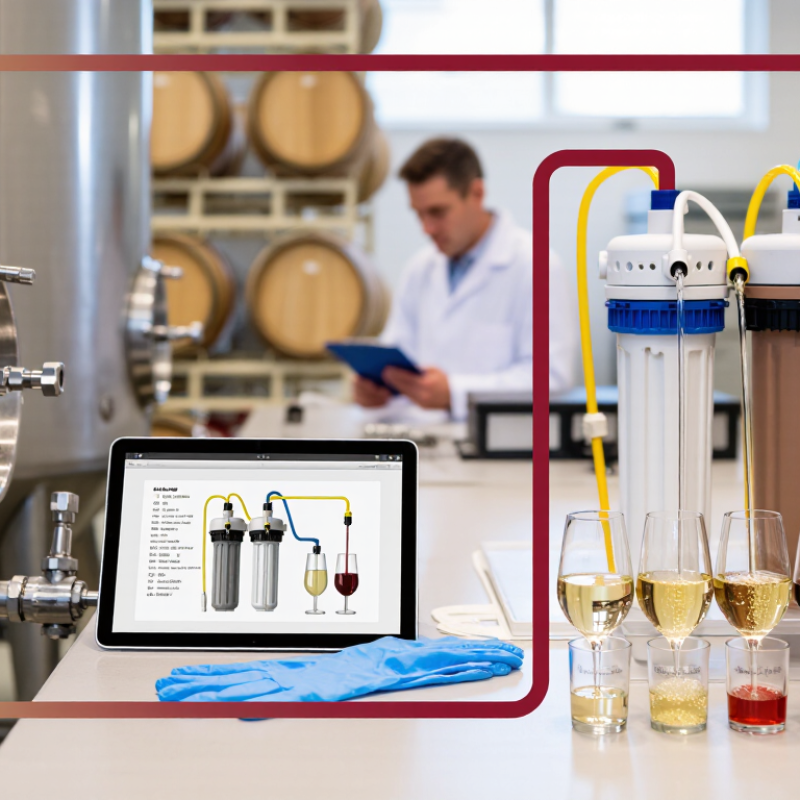
Define Filtration Goals Using 0.45–0.65 µm Sterile Membrane Benchmarks
How to Choose the Best Wine Filters for Global Buyers
Wine filtration should begin with a measurable goal, not a catalog choice. The 0.45–0.65 µm range offers a practical benchmark for fine membrane screening. A 0.65 µm membrane may protect aroma and reduce visible haze with gentler flow. A 0.45 µm option can provide tighter particulate control and stronger microbial reduction. Neither rating proves sterility by itself. Sterile processing requires validated equipment, sanitation, integrity testing, and controlled handling.
A winery should record turbidity, flow rate, pressure, and dissolved oxygen before and after filtration. Small trials matter. Pour the same wine through each membrane at matching pressure. Then compare clarity, aroma, color, and filter loading after 24 hours. I have found that a fast filter is not always the best filter. Excessive pressure can strip character or increase oxygen pickup. That detail is easy to miss.
Global buyers also need material compatibility, traceability, and documented test methods. Confirm that the membrane, housing, seals, and wine-contact parts suit the product and destination requirements. Ask for extractables data, batch records, and clear operating limits. Local rules differ, and translated specifications can create misunderstandings. Keep a retained sample from every trial. It may reveal a problem later. A 0.45–0.65 µm benchmark is useful, but the final choice should reflect the wine, process, and verified result.
| Filtration Goal | Recommended Nominal Pore Benchmark | Typical Wine Application | Primary Target | Expected Process Effect | Key Selection Criteria | Validation Requirement |
|---|---|---|---|---|---|---|
| Coarse clarification | 3–10 µm | Removal of visible particles, grape fragments, lees, and gross sediment before fine filtration | Large suspended solids | Reduces downstream loading and extends the service life of finer membranes | High dirt-holding capacity, low pressure drop, suitable depth or screen construction | Measure turbidity and differential pressure before and after filtration |
| Fine clarification | 1–3 µm | Pre-filtration after settling, centrifugation, or coarse depth filtration | Fine lees, colloidal aggregates, and residual suspended matter | Improves visual brightness while limiting premature blockage of final filters | Flow capacity, solids-loading tolerance, and compatibility with the wine matrix | Compare turbidity, flow rate, and pressure rise under defined operating conditions |
| Polishing filtration | 0.8–1.2 µm | Brightening finished wine before final membrane treatment | Small particles and remaining haze-forming material | Provides a cleaner feed stream and can reduce final-filter fouling | Low extractable risk, adequate throughput, and minimal impact on aroma and color | Check turbidity, sensory profile, color, and pressure differential |
| Microbial-reduction benchmark | 0.65 µm | Intermediate microbial control for relatively clear wine before tighter filtration | Many yeast cells and a portion of larger microbial contaminants | Reduces microbial load but should not automatically be treated as sterile filtration | Validated retention performance, low fouling tendency, and chemical compatibility | Use organism-specific retention or microbial challenge data; monitor integrity and pressure |
| Fine microbial-reduction benchmark | 0.45 µm | Final or near-final filtration of well-clarified wine when the process specification supports this rating | Yeast and many bacterial cells, subject to organism size and membrane design | Can substantially reduce microbial passage and improve package stability | Validated pore rating, membrane area, flow rate, maximum differential pressure, and low adsorption | Confirm retention with relevant challenge testing; conduct pre-use and post-use integrity testing where applicable |
| Validated sterile-grade filtration | Typically 0.20–0.22 µm | Processes requiring a documented sterile-filtration claim under controlled conditions | Microorganisms, including smaller bacterial cells that may pass coarser membranes | Offers a stronger microbial barrier when properly validated and operated | Validated bacterial retention, sterilization method, integrity-test compatibility, and aseptic handling | Use a recognized bacterial challenge approach and a validated integrity test; 0.45 µm alone should not be labeled sterile without evidence |
| Wine-style compatibility | Applicable to all selected ratings | Red, white, rosé, sparkling, fortified, and low-alcohol wines | Wine-specific risks such as ethanol, acidity, sulfur dioxide, polyphenols, proteins, and colloids | Influences throughput, membrane life, aroma retention, and potential product loss | Verify pH, alcohol tolerance, temperature range, extractables, adsorption, and cleaning or single-use requirements | Run product-specific trials using representative wine, not water alone |
| Capacity and sizing | Supplier-specific; size by validated flux | Small cellar batches through high-volume bottling lines | Required throughput and acceptable operating time | Determines membrane area, number of housings, changeout frequency, and total cost | Use actual wine flux rather than clean-water flow; include viscosity, temperature, and fouling allowance | Record flow, inlet pressure, outlet pressure, differential pressure, and processed volume |
| Operational control | Defined by process specification | Routine filtration with repeatable quality across sites and export markets | Process consistency and package stability | Reduces variability caused by pressure spikes, poor pre-clarification, or excessive filtration speed | Controlled differential pressure, sanitary connections, documented batch records, and operator training | Set acceptance limits for turbidity, microbial results, pressure, flow, and membrane integrity |
| Buyer guidance: A 0.45–0.65 µm rating is a useful benchmark for comparing fine microbial-reduction options, but pore size alone does not prove sterility. Select the membrane using validated retention data, wine-specific compatibility testing, operating limits, and the required finished-product specification. | ||||||